

Applying Agile Methodology in Industrial Automation
News | 2026-09-09

Industrial automation projects typically involve multiple disciplines, including MES, PLC, SCADA, robotics, electrical engineering, mechanical design, instrumentation, safety systems, and equipment integration. Traditionally, these projects have been managed using a Waterfall approach, where requirements, design, implementation, testing, and commissioning are executed sequentially. While this model provides structure and predictability, it may struggle to accommodate changing requirements and evolving business needs.
Agile methodology offers a more flexible approach based on the principles of collaboration, transparency, inspection, and adaptation. Its core values emphasize customer involvement, frequent delivery of working solutions, and the ability to respond quickly to change. Through iterative development cycles and continuous feedback, Agile helps teams reduce risk, improve solution quality, and deliver value earlier in the project lifecycle.
However, not all areas of industrial automation benefit equally from Agile practices.
Software-intensive disciplines such as MES development, SCADA/HMI applications, PLC programming, robotics software, analytics, and digital transformation initiatives are particularly well suited to Agile. Requirements in these areas often evolve during the project, and users can provide valuable feedback after interacting with early versions of the solution. Incremental development allows teams to refine functionality and optimize performance throughout implementation.
Conversely, disciplines such as electrical design, mechanical engineering, safety systems, equipment procurement, and construction activities are generally more predictable and constrained. These activities typically require detailed upfront planning, approved designs, compliance with engineering standards, and long procurement or fabrication lead times. For such work, a traditional Waterfall approach often provides better cost, schedule, and risk control.
As a result, most industrial automation projects benefit from a Hybrid approach. Predictive methods are used for physical infrastructure and engineering design, while Agile practices are applied to software development, system integration, and process optimization. This combination enables organizations to maintain engineering rigor while gaining the flexibility and responsiveness needed for modern manufacturing environments.
The following sections explore how Agile principles can be effectively applied to MES, PLC, SCADA, and robotics development within the broader context of industrial automation projects.
Understanding Agile in an Industrial Context
Agile is based on iterative and incremental development. Instead of delivering a complete solution at the end of a long project cycle, the team delivers smaller functional increments in short development cycles called sprints.Core Agile principles include:
• Continuous stakeholder collaboration
• Frequent delivery of working solutions
• Adaptability to changing requirements
• Continuous improvement
• Cross-functional teamwork
In industrial automation, Agile must be adapted to account for operational constraints such as equipment availability, production schedules, validation requirements, and safety regulations.
Why Agile Matters in Industrial Automation
Manufacturing environments face several challenges:• Frequent changes in production requirements
• Multiple stakeholders (operations, maintenance, quality, engineering, IT)
• Integration with legacy equipment
• Uncertain requirements during project initiation
• Pressure to reduce commissioning time
Traditional project approaches often struggle to accommodate these realities.
Agile provides several advantages:
Faster Delivery of Value
Rather than waiting months for a complete MES deployment, teams can release:
• Initial production tracking
• OEE dashboards
• Electronic work instructions
• Quality data collection modules
one feature set at a time.
Earlier User Feedback
Operators and supervisors interact with working systems earlier, allowing adjustments before significant effort is invested.
Reduced Project Risk
Problems are discovered during short development cycles instead of at final commissioning.
Better Alignment with Business Needs
Changing priorities can be incorporated into subsequent sprints without derailing the entire project plan.
Agile in MES Development
MES projects are particularly well-suited for Agile because they resemble enterprise software development.
Traditional MES Approach
A typical Waterfall MES project often includes:
1.Requirement gathering2.Functional specification development
3.Detailed design
4.Configuration and coding
5.Factory Acceptance Testing (FAT)
6.Site Acceptance Testing (SAT)
7.Go-live
This process can take many months before users see any functionality.
Agile MES Approach
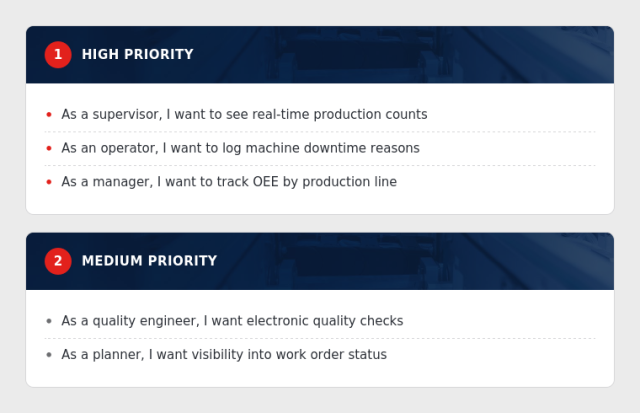
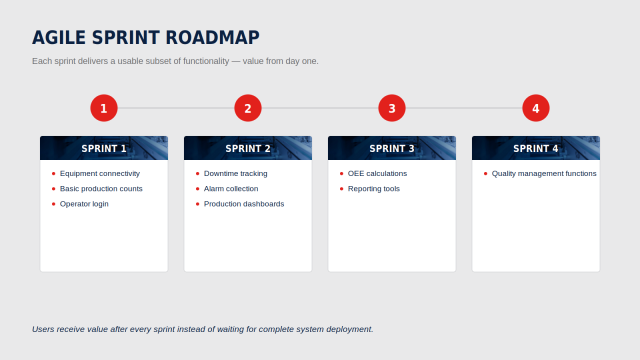
Using Agile, the MES solution is divided into manageable features.Example Product Backlog
Example Sprint Sequence
Agile in PLC Development
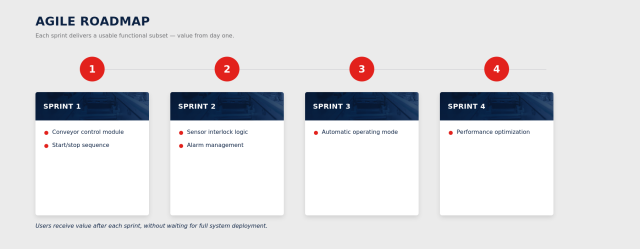
Applying Agile to PLC projects requires some adaptation because hardware dependencies and commissioning activities are involved.Challenges
PLC development is different from business software because:
• Physical equipment is required
• Machine safety must be maintained
• Hardware changes can be costly
• Production downtime may be limited
Nevertheless, Agile concepts can still be highly effective.
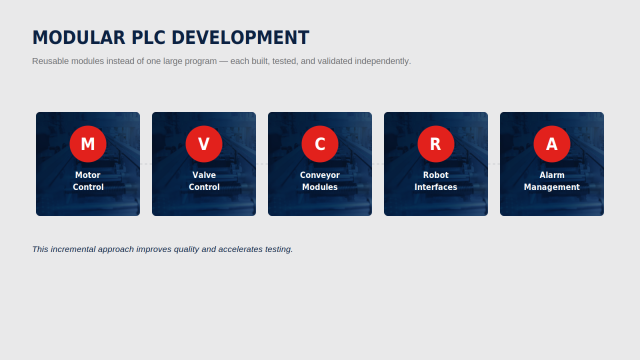
Modular PLC Development
Agile PLC development emphasizes modular programming.
Sprint Example
Agile in SCADA Development
SCADA systems are highly suited for Agile implementation because operator interfaces can be developed incrementally.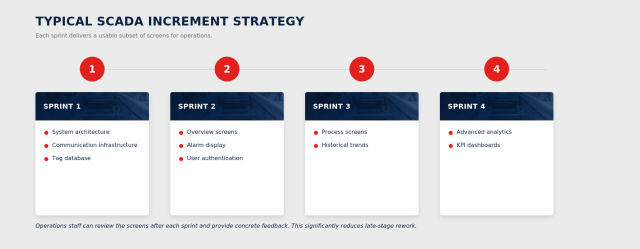
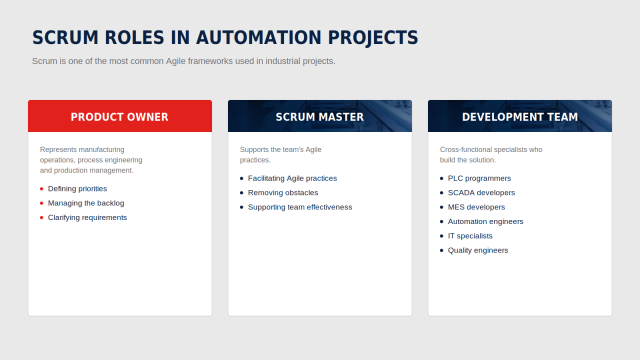
Using Scrum in Automation Projects
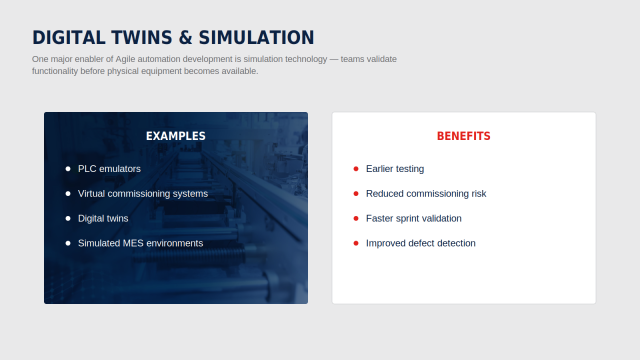
Digital Twins and Simulation Support Agile Development
Measuring Success
Key performance indicators for Agile automation projects include:
Delivery Metrics
• Sprint completion rate
• Lead time
• Cycle time
Quality Metrics
• Commissioning defects
• Production incidents
• Defect escape rate
Business Metrics
• OEE improvement
• Downtime reduction
• Scrap reduction
• Faster product changeovers
Customer Satisfaction Metrics
• User acceptance scores
• Stakeholder feedback
• Adoption rates
Delivery Metrics
• Sprint completion rate
• Lead time
• Cycle time
Quality Metrics
• Commissioning defects
• Production incidents
• Defect escape rate
Business Metrics
• OEE improvement
• Downtime reduction
• Scrap reduction
• Faster product changeovers
Customer Satisfaction Metrics
• User acceptance scores
• Stakeholder feedback
• Adoption rates
Common Challenges
While Agile offers significant advantages, several obstacles must be addressed.Hardware Dependencies
Software may be ready before equipment installation.
Mitigation:
• Use simulations and virtual commissioning.
Fixed Production Shutdowns
Some testing opportunities occur only during planned outages.
Mitigation:
• Align sprint planning with maintenance windows.
Regulatory Requirements
Industries such as pharmaceuticals and food manufacturing require extensive validation.
Mitigation:
• Include documentation and validation activities within sprint deliverables.
Cultural Resistance
Many automation organizations are accustomed to traditional project execution.
Mitigation:
• Start with pilot projects and demonstrate quick wins.
Industries such as pharmaceuticals and food manufacturing require extensive validation.
Mitigation:
• Include documentation and validation activities within sprint deliverables.
Cultural Resistance
Many automation organizations are accustomed to traditional project execution.
Mitigation:
• Start with pilot projects and demonstrate quick wins.
Best Practices
Successful Agile implementation in industrial automation often includes to:
1. Develop a prioritized product backlog.
2. Deliver small functional increments.
3. Engage operators early and frequently.
4. Use modular PLC architecture.
5. Implement virtual commissioning tools.
6. Automate testing where possible.
7. Include documentation in the Definition of Done.
8. Conduct regular sprint reviews with production stakeholders.
9. Measure value delivered rather than code produced.
10. Foster close collaboration between OT and IT teams.
1. Develop a prioritized product backlog.
2. Deliver small functional increments.
3. Engage operators early and frequently.
4. Use modular PLC architecture.
5. Implement virtual commissioning tools.
6. Automate testing where possible.
7. Include documentation in the Definition of Done.
8. Conduct regular sprint reviews with production stakeholders.
9. Measure value delivered rather than code produced.
10. Foster close collaboration between OT and IT teams.
Toward more agile and high-performing automation
Agile methodology offers a powerful approach for modern industrial automation projects. While MES development naturally aligns with Agile software practices, PLC and SCADA development can also benefit significantly when modular design, simulation technologies, and iterative delivery are employed.
By emphasizing stakeholder collaboration, incremental delivery, frequent testing, and adaptability, Agile helps automation teams reduce risk, improve system quality, accelerate deployment, and deliver business value sooner. As manufacturing continues its digital transformation journey under Industry 4.0 initiatives, Agile methodologies are becoming an increasingly important component of successful MES, PLC, and SCADA project execution.
By emphasizing stakeholder collaboration, incremental delivery, frequent testing, and adaptability, Agile helps automation teams reduce risk, improve system quality, accelerate deployment, and deliver business value sooner. As manufacturing continues its digital transformation journey under Industry 4.0 initiatives, Agile methodologies are becoming an increasingly important component of successful MES, PLC, and SCADA project execution.
Share on: